Wednesday, November 18, 2009

Legends of Print (#3)

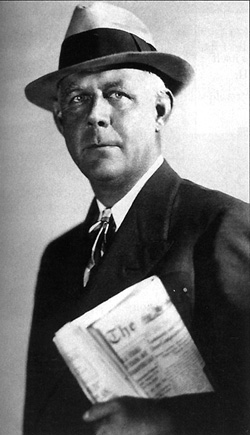
With the third installment of "Legends of Print," I introduce the "greatest golf writer in history," Mr. O.B. Keeler.


This photograph speaks volumes greater than I ever could; Mr. Robert Jones (left) with Mr. O.B. Keeler (right) and Mr. Jones' 1930 grand slam trophies.

An excellent article from 2007 by Sports Illustrated's John Garrity about Mr. O.B. Keeler.

From a 1924 article published in The American Golfer:


Returning with a degree from Harvard University toward the middle of February, Bobby Jones brought home to Atlanta along with a considerable portion of classical education a new engineering idea in the matter of long-range golf clubs which he has lately put into practical execution, somewhat over the protest of his friend and mentor, Stewart Maiden, who at the outset declared himself briefly but firmly as distinctly not in favor of his star pupil's departure from the accepted and established form and make of such implements. In a word, while at Cambridge, in the interludes of battling with Cicero against the iniquitous Cataline, and other scholastic problems, Bobby hauled out his old drawing instruments, used at the Georgia School of Technology, and made a set of drawings for a pair of wood clubs which, I am convinced, are unlike any the ancient game has yet produced. I understand that when Mr. Maiden got his first glimpse of the prodigious heads of these golf clubs, made to Bobby's design by A. G. Spalding and Bros., he expressed the opinion that if they represented truly the mechanical inclination of Bobby's mind, he (Bobby) would better have omitted the mechanical engineering course at Tech and have gone to Harvard in the first place.

As a proponent of wood clubs with large heads and faces, the writer cannot but feel eminently gratified by this expression of the American open champion's ideas. Certainly these new clubs have large heads and ample faces—the largest and amplest I have ever seen; larger, I feel sure, than the largest of the original Dreadnoughts designed and executed by the diminutive and original Benny Sayers some fifteen or twenty years ago. And it must be said that with the new weapons Mr. Jones is achieving results in his rounds at East Lake and Druid Hills; he is hitting a tremendous length from the tee and through the green, on the infrequent occasions when his drive leaves him a full clout with the wood to get home. The trend of recent years has been away from the small, compact heads and short faces, of which there was an epidemic some years ago among the manufacturers—for what reason the writer never has been able to figure out, unless it was easier to get smaller suitable chunks of persimmon than large ones. It may be recalled that three years ago I wrote for The American Golfer an almost tearful protest against this fad, which was positively afflicting the golfing laity and the beginners at the game, who knew no better than to buy and essay to use what was on the market. I said then that the small head with the small face made a hard game harder; and directed attention to the fact that most of the great golfers, both amateur and professional —but especially professional— employed wood clubs with heads ofgood size and plenty of hitting surface, citingHarry Vardon, Abe Mitchell and George Duncan as particular examples. Bobby never fell for the small-head fad. Indeed, he had his clubs made with faces deeper and deeper, until the driver he was using at Inwood, when he won the open championship, had a face nearly two inches in depth, though quite narrow at the sole.

The driver and brassie he now is using, of his own design, are of a size almost colossal. I am informed that they were even larger, as they came from the factory to the shop of Stewart Maiden, where heads and shafts were to be assembled; and that there were words—short, strong Caledonian words—heard in that shop before the clubs were duly put together. Indeed, there was a compromise; I am told that fully an eighth of an inch was taken from the club-heads in every direction before they finally were spliced to the beautiful bamboo shafts, by the old method of a "scared" joint. The first time I saw the clubs I told Bobby the heads really ought to be stream-lined, to lessen the air resistance in the swing. They give that impression. If you will pick out the largest of your wood clubs and compare the measurements with the following, of Bobby's new driver, you will gain something of an idea as to the expansiveness of his design. The face, with only enough loft to enable the player to see the lower edge with the club grounded— practically no loft at all—is 1 9/16 inches in depth, three inches long at the top, and 1½ inches long at the sole. The head measures 3 inches across the top at the widest point, front to back. The bulge is so emphatic that a line drawn across the top of the head from one extremity of the face to the other will show a protuberance of 3/8 inch at the middle of the rounded hitting surface.


I can get with conventional clubs, and the ball has much more life and run after it takes the turf. In other words, the tendency to 'climb' by a ball hit with much backspin seems to be almost obviated. Hit in the back with this club, the ball seems rather to bore its way through the air and to retain considerable running ability on landing. I think it will be a good club for use in a hard wind. I find also that I can hit as hard as I please without the 'climbing' tendency taking length off the shot." Two well-established theories are found supporting this idea—that backspin causes the ball to climb, and that a deep face tends to keep the ball down. How Bobby reconciles the equal carry of the ball hit with the new club with that from the older weapons, with backspin, I do not profess to explain. I fancy he simply swats it harder. Of course it is obvious that only the most accurate swing can be relied on to hit the ball regularly "in the back" from so lofty a tee; similar ambitions by anyone but an expert would meet with blue ruin in disastrous proportion. Bobby has an exceedingly accurate swing; it requires that to take the highteed ball exactly at the start of the upward motion of the club, and not smother it with the unlofted face. The plan may not be original; I think Walter Hagen tried out something very like it two years ago. But the design of the clubs, and their heroic size, will stamp this latest endeavor at least as distinctive, and Bobby's further experimentation will be watched with considerable interest. face—the most startling bulge I ever saw on a golf club. The driver weighs 13½ ounces, of which 7½ ounces are in the head and 6 ounces in the shaft; radical departure from the old proportions in wood clubs, which usually had the weight of head and shaft approximately equal. This significant change was made possible by the bamboo shaft, which is lighter in proportion to its stiffness than a hickory shaft. In fact, a friend of Bobby's, having one of the sample club-heads made up with a hickory shaft, found that the resultant club was so heavy that no lead could be used in the head. Very little lead is used in the head of Bobby's driver; only three-quarters of an ounce, in cylindrical form, half an inch in diameter, set directly back of the correct point of impact and extending three-quarters of an inch into the head. The length of the club over all is 44 inches. The bamboo shaft is stiff, yet there is a bit of "feel" to it. "So heavy a club needs to be 'felt' for timing the swing," Bobby explains. "I think if I got a hickory shaft light enough to enable me to 'feel' the head, it would have too much whip. I don't believe a hickory shaft of six ounces could be found or made that would have backbone enough to stand up under the fast swing of a club like this." And now the effect of this remarkable combination, with the celebrated Jones string. Bobby's own theory follows: "I tee the ball about three-quarters of an inch high and try to hit it directly 'in the back.' This stroke, with a deep-faced club with practically no loft, seems to give me as long a carry.


Also, how amazing is this . . . A letter sent from O.B. Keeler to Walter Hagen on the 25th Anniversary of his 1914 U.S. Open victory.


It is difficult to read, so I transcribed it below:


My dear Walter:
After all, it was Alexandre Dumas who could have come nearest to doing justice to this Silver Anniversary of your first winning of the United States Open Championship, August 21, 1914. And M. Dumas might have well titled it, "Twenty-five Years After."

My dear Walter, it's not only to a geat champion and the greatest competitor that I take the hat off my graying old bean; it's to the gentleman and the sportsman who for the span of more than a quarter of a centrury has been playing the game -- playing the game of life as well as the game of golf. And in congratulating you, I'm congratulating these games, both of them, and also myself, in being lucky enough to know you. A thousand friends will be telling you that, on this Silver Anniversary, but none who means it more sinceerly and affectionately than
         Your faithful friend and admierer,
                    O.B. Keeler

Photo(s): Bobby Jones, O.B. Keeler letter,

Tuesday, November 17, 2009

Thanksgiving Day Post Preview

Friends,

While I'm typically of the school that Thanksgiving only presents an opportunity to drink massive amounts of wine and consume absurd amounts of food before 3:00p.m., I'd like to open "Never Three Putt" to all who have a golf story that represents the nature of Thanksgiving. I'm not looking for tales of conquer and submission, but rather want to know a story that symbolizes why you are thankful to have golf in your life.


I'll be collecting stories over the next week (expect to see this reposted as a reminder) and will post them throughout Thanksgiving Day.

Until then, be well.

Stories can be e-mailed to me directly at MichaelOtt23@gmail.com . . .

Photo(s): Thanksgiving

Tuesday Reader . . .


https://filebox.vt.edu/users/tjmurphy/fark/barkley-fark.jpg


A look at what my contemporaries, and superiors, have done.

So, sit back, listen to these and think about these . . .

Johnny Nash - Ooh Baby You've Been Good to Me (Via: Armed Snobbery)


Milton Wright - Keep it Up (Via: Armed Snobbery)


When it comes to sports, the opposite of passion and love (the most overused word in English, by the way) is not hate. The opposite of love in sports is apathy. You don't win the career grand slam and have a hall-of-fame career if you are apathetic. That is why I want to read Agassi's book—there had to be a time in his nearly 20 years of professional tennis where it was the most important thing in his life. I am guessing that he suffered a bit of the David Duval syndrome. David reached the height of his profession, grabbing the No. 1 spot in the world ranking, looked around and asked the question: "Is this all there is?"
I knew David before he became No. 1. I remember being at his house in Florida one afternoon. After a day spent on the practice range, he continued his offseason routine with a workout and I decided to join him. By the time David's workout was over I had long since finished mine, showered, had a snack and was on my third beer. And I was more than satisfied with the work that I had put in that day. I had been on TOUR for a few years and had found my own routine, but I discovered that day there were people like David whose entire existence was consumed with the art of becoming the best. And that existence comes with a price tag only guys like David and Andre know.
Q: When you stopped playing on the LPGA, you said you didn't want to use the R word, meaning retirement. Is that still the case?
A: Yeah, I said, "I'm stepping away," and the reason is because, like you said, you never know. I'm lucky in that if I wanted to come back, I could. But I'm very content with where I am today and what I'm doing and all the businesses and family life. So today I have no plans whatsoever, but things change. In five years? I don't know. I certainly don't have the desire to go out there and grind, and that's what it takes. There are times when I wish I had that motivation, because then I would be out there. But with all this other fun stuff, there's more to life than golf. I'm glad that I've found other things in life and can enjoy a different chapter. 
Q: What drives you to these other pursuits? Is it money? Passion? Boredom relief?
A: Well, it's passion. And, you know, I'm competitive. I love the challenges that business gives me. It's different than on the golf course; on the course, it's hitting a 7-iron or making a putt or competing against the best in the world. Here it's different, but my goal is to get the Annika brand out there. If you look at other athletes, some have been very successful in creating businesses after athletic careers, but a lot of them are men. I can't think of a female athlete who has really done that. There have been many who were extremely good in their own field and have done some things around their sport, but no one's really ventured out into different areas. I'm really curious as to why that is. I love what I do and therefore I spend a lot of time on it and want to succeed. 
Q: After clinching the win, you had beer poured on you by the other players on the 18th green.
A: Yeah, they did.

Q: You're not 21 yet. Are you going to get in trouble with the LPGA?
A: No, what happens in Mexico stays in Mexico. It was just really cool. You see it on TV; whenever somebody wins, players pour beer all over them. It was one of those things where I always wanted that to happen. 

Q: You keep talking about being happy. What makes you happiest? Is it winning golf tournaments? Your family life? Being with friends? All of the above?
A: I think it's a combination of everything. It's a balance. My friends definitely make me happy; my family definitely makes me happy; winning golf tournaments definitely makes me happy. It's just a little reward that I get, knowing that I put in the long hours, just the gratitude and the relief, everything that I feel.
When the hard work pays off, it just feels so great. And then, having another life, going to Stanford makes me so happy. I can't even put it into words. I love going to school. I love having a normal life, going to football games, going to basketball games, going out to eat with my friends. I love the balance that I have in my life. I've got a good mix of everything.
"Wie first burst onto the scene as a precocious 13-year-old, finishing in a share of ninth place at the year's first women's major, but it was her inclusion at the 2004 Sony Open that vaulted her into the role of global phenomenon. Playing against the world's best male golfers, she posted rounds of 68-72 at her hometown event, failing to make the cut by a single stroke.
In a society that thrives on underdog stories, in a generation that values diversity and culture, the youngster should have been considered the game's most exciting prospect in years. And she was ... for a while.
A funny thing happened to her, though, on the road to superstardom, and perhaps just as importantly, likability. Wie turned professional at age 16. She was handed millions of dollars from sponsors Nike and Sony. She was awarded sponsors' exemptions to events on men's tours. She was hailed by the media as the female version of Tiger Woods. She was given everything she asked for. And much, much more.
Through injuries and swing changes, close calls and major whiffs, she seemed to regress on the course, eclipsed by other young peers who were winning important tournaments. That's when the public backlash against her really began, when pure malice for a teenaged girl became commonplace, when the world started hating Michelle Wie."
Ziegler, 52, is a Wisconsin native who runs an investment firm that reportedly has multi-billions of dollars in assets. He carries a 6-handicap, and his favorite courses are San Francisco Golf Club, Cypress Point and Augusta National.

Despite the upbeat meet-and-greet with USGA brass, Ziegler won’t discuss the possibility of hosting an Open. He will only talk about two specific goals: “I want to get the course in terrific condition, and I want to make sure it’s ready for the Amateur in 2011.”

Ziegler’s doing so by increasing the maintenance budget, building a state-of-the-art maintenance shed, purchasing the proper equipment and increasing the size of the crew. The 10th hole is being converted from a par 5 to a par 4, which will reduce total par from 73 to 72. He’s addressing a drainage issue on the 17th, and architects Mike Hurdzan and Dana Fry have begun doing away with some of the 103 bunkers that were added in the last 10 months.

The new owner says he didn’t invest in Erin Hills to make a profit. “I realize it has enormous potential,” says Ziegler, “but I didn’t buy into it to make money. I wouldn’t have advised anyone to buy into the golf industry right now. But it’s the intersection of my enjoyment for the game, and it’s good for the area. In a small way, it’s my way of giving back to golf.”

Erin Hills is closed for the winter. And it might remain that way until late summer. Ziegler says the target date for reopening is Aug. 1. “But if it’s not ready, we won’t open,” he says. And he’s willing to keep it closed all year if necessary. He wants the course ready for the Amateur.

When the course does open, Ziegler says the fee will be $160; it will be walking only, he’ll decrease the number of tee times from five per hour to four per hour to ease stress on the grass and speed up play. “We will be ready,” says Ziegler, “but there’s a lot of work to be done.” 
"One of Barron's attorneys said Friday that in several instances, tour players have tested positive this year for recreational street drugs, which are not subject to the same penalties as performance-enhancing doses. The tour argues that a player smoking pot, of course, is not seeking a potential advantage since it's not a performance-enhancing drug. 

Plenty of rumors have circulated this year about positive tests -- Barron's attorney offered no names or first-hand knowledge to support his claim -- but if the case continues in court, the tour could be asked to give an account. Earlier this season at the one-year anniversary of testing, tour commissioner Tim Finchem said that while no positive tests for steroids had turned up, he did not deny that players had tested positive for recreational drugs.
The tour has repeatedly declined to name those players and Finchem, in a jarring conflict of interest that has been decried several times, has complete latitude to dispense punishment for recreational-drug use as he sees fit. In other words, he can do next to nothing and nobody but the offending player would know the nature of the sanction. The tour has never announced fines for disciplinary actions, another frequent point of criticism."


And, an excerpt from my interview with Alistair Tait of Golfweek:


"I lament the death of the golf essay. One of the first books I ever read was by Herbert Warren Wind. I remember reading Thomas Boswell's Strokes of genius and falling in love with the game all over again. I also grew up reading Peter Dobereiner, loving the sheer craft of the man and his grasp of the game and the written word. Dan Jenkins' take on the majors was also required reading too, even if it came weeks after the close of the championship. He always had something original and witty to say, always highlighted an aspect others hadn't seen.
Sadly, the days of sitting down with a good golf essay, or long Dobereiner like piece on the eccentricities of the game are long gone. It seems these days that if you can't reduce your observations to 140 characters or less then no one will read you."

Photo(s): Charles Barkley

Monday, November 16, 2009

Tiger = Professional Javelin Thrower

At the Australian Masters on Saturday, Tiger had a . . . well, temper tantrum on the 13th tee box.


Via: PGA of Australia
Woods played down an incident on the 13th tee where his driver ended up in the gallery after a wayward drive.
"I was spinning the ball quite a bit with the driver today and I didn't quite have it right," he said. "On 13 it was my mistake there, I got hot after a bad tee shot and let go of the club."

Throughout his career, Tiger has had a history of showing his emotions, which are often unpleasant, on the course.


Obviously, it would be inappropriate to excuse Tiger's actions, but they should at least be presented within context.

There is not something afoul in Tiger Woods-land. Tiger Woods is receiving unprecedented stardom from golf; he's positioning himself as one of the quintessential global icons of our time. Not only did he recently establish himself as the world's first athlete billionaire, not only will he likely eclipse all essential golf records within the next few years, not only is he the best golfer in the world and seemingly the most dominant athlete today, but he's one of the most influential, visible, and recognizable figures in the world.

"One day, when Tiger was just a kid, he was throwing his clubs around in a fuming fit when his dad said something like "Tiger, golf is supposed to be fun." And Tiger said, "Daddy, I want to win. That's how I have fun.""

Tiger does obviously need to be aware of his behavior because he is such an influential figure. But, ultimately, it is Tiger's temperament, his tightly-wound personality, and his unquestionable driving temperament that has made him the greatest ever. Tiger seems to expect more from himself than his peers; he openly states that, when he arrives on the first tee on Thursdays, he expects, not believes, not hopes, but EXPECTS to win.

I hope in the future that Tiger will curb his temper. As someone who has been unprecedentedly influenced by Tiger Woods in his golf and as someone who has witnessed (and, at times, participated in) the immature behavior, cattiness, and volatility that is junior golf, Tiger does need to accept his platform as golf's leading role-model.

However, I'm always willing to give the man a break as he keeps winning, keeps serving as a sports paradigm both on and off the course, and keeps doing this . . .

Play peacefully, not violently . . .

-Michael

Saturday, November 14, 2009

A plan for the success of the LPGA Tour

Yesterday I listened to Annika Sorenstam on ESPN's "On The Tee" podcast (11/10) with Jason Sobel.

Their interview touches on a number of LPGA Tour specific issues. Most interesting was Jason's question about the future of the Tour:

Jason: Is the future of the tour that of a more global tour (Japan, Korea, Mexico)?
Annika: Yes, we should be more global. Have more tournaments around the world. That is where the demand is, companies are more interested in Europe and Asia.

After thinking about it for sometime, here is a plan for the future success of the LPGA Tour as an international tour.

http://www.tdgagolf.org/images/links/LPGA_tour.jpg

Here's the situation (via: Golfweek)

Of this year’s 16 scheduled U.S. tournaments (excluding majors), 13 – at best – will return for the 2010 schedule. Three events already are defunct: Turtle Bay (formerly SBS Open), Kapalua LPGA Classic and LPGA Corning Classic.

At least seven of these events have title-sponsorship contracts expiring this year. Among this group, tournament owners of the Sybase Classic, P&G Beauty NW Arkansas Championship and Navistar LPGA Classic are optimistic about continuing in 2010.

At least four are under contract through at least 2010: Safeway Classic, CVS/pharmacy LPGA Challenge (name changed following acquisition of Longs Drugs), Bell Micro LPGA Classic and Tour Championship.

The LPGA is launching a new event in Southern California next year with J Golf, the tour’s Korean cable TV partner. In addition, LPGA State Farm Classic has committed to return.

On the international front, the tour announced July 21 the creation of another tournament in Mexico beginning in 2010: the Acapulco LPGA Classic, to be held next spring at Tres Vidas Golf Club. Two of the LPGA’s three existing events in Mexico are up for renewal this year: MasterCard Classic and Corona Championship. MasterCard’s status is uncertain; Corona hasn’t officially committed, but event organizers have expressed confidence the event will continue. The third event, Lorena Ochoa Invitational, is under contract through 2012.

In addition, the Evian Masters’ contract expires in 2009, but a tournament official said "all the lights are green for a renewal." Tour officials also said Honda LPGA Thailand and CN Canadian Women’s Open are part of the 2010 schedule.
As has been illustrated over the past few weeks throughout the golf media, the LPGA Tour is facing a dire financial situation as corporate affiliations are disappearing and general interest in the Tour is dwindling.

Of the 29 Tournaments listed on the 2009 LPGA Tour Schedule, foreign title sponsors of note:

SBS - Korea based
Honda - Japan based
HSBC - England based
Corona - Mexico based
Societe Generale - France based
RICOH - Japan based
CN - Canada based
Samsung - Korea based
Hana Bank -Korea based
Mizuno - Japan based
Banamex - Mexico
Rolex - Switzerland based

American based: Nextel, Mirassou Winery, Kraft Nabisco, Michelob, Sybase/ShopRite, Corning, State Farm, McDonalds/Coca-Cola, Wegmans, Kroger, US Open (no title sponsor), Solheim Cup (no title sponsor), Safeway/Coca-Cola, Procter & Gamble, Navistar/Monaco RV, Wendy's.

The current Rolex Women's World Golf Rankings (11/09/09):
Of the top-30:
       Korean: 9
       American: 7
       European: 6
       Japanese: 5
       Australian: 2

With the evident international interest and international presence on the LPGA Tour, there is an obvious opportunity for the LPGA Tour to exploit their international advantage.

While there is an international interest in women's golf, it's important to note that the purse sizes on the Ladies European Tour approximately average €300,000 ($500,000) while every LPGA Tour purse was over $1 million, with many over $2 million.

My  proposal would be to follow a men's European Tour model where there is no clear base-country for the Tour. Unlike the European Tour, obviously, an international LPGA Tour would have a multi-contintent schedule.

The LPGA Tour schedule would be comprised of the most successful American tournaments, the title-sponsored events with foreign corporations would be moved to those respective countries (something those corporations would hardly have an issue with), and the LPGA schedule would then be joined with the most successful tournaments from the Ladies European Tour and the Ladies Asian Golf Tour (the 2010 schedule has four events: China, Indonesia, India, and Thailand).


Obviously, this would create a traveling burden on the players, but I believe that increased incomes via tournament purses and international corporate affiliations would be make up for it.

The mission statement for the LPGA Tour reads: "To inspire, empower, education and entertain by showcasing the best professionals in the world -- The members of the LPGA. To be a leader in the world of sports and to promote economic empowerment for our members. We will also serve as role models on and off the course."

While an international tour would make it more difficult for American players to have an arena to compete, it's always been my understanding that professional sports are meant to provide an arena for, simply put, the best to compete. While there is an obvious xenophobia about the LPGA Tour, it is a misguided notion to believe that its purpose is to house American female golfers.

The LPGA needs to go to a more stringent international schedule or they will continue to face economic instability. Particularly, as it seems that many American corporations are going to cut down on wasteful spending (I'm not labeling LPGA Tour affiliations as wasteful, but rather implying that there are, perhaps, better uses of that money) it seems unlikely that corporations will be adamant about maintaining their title sponsorships.

Jason also asked Annika if the LPGA Tour needs another dominant figure (as she was) or if it would be better served by having a core-group of 20 players who compete well with each other week in week out. Annika's response was noncommital, but she did point out that during her time some criticized the tour and labeled it as boring because she was winning all of the time.

On a side note, I interviewed Jason Sobel last week for a project on the future of golf journalism and golf media. Obviously, he was incredibly well informed, but, most importantly, he was kind and generous to offer me so much time late in the evening -- our conversation lasted until after midnight.

I encourage my readers to follow him (at his ESPN blog) and the work that he does; not only is he setting the quo for the future of online golf media (which, frankly, is the future of golf journalism), but today he is doing great work and providing great insight.

Photo(s): LPGA Tour

Tuesday, November 10, 2009

Stop hating on Phil. . .


Jason Sobel, who I will be interviewing tomorrow, blogged yesterday about the potential Tiger Woods, Phil Mickelson rivalry which may unfold this year:


"That leaves Mickelson, one of the most accomplished players in the game's history who often receives criticism simply for the fact that he isn't Tiger Woods. At his best, though, Lefty can hang with his adversary on any given Sunday, as evidenced by victories at the Tour Championship two months ago and the WGC-HSBC Champions tournament this past weekend in China."


"He has now finished off the 2009 campaign playing his best golf since winning back-to-back titles at the BellSouth Classic and Masters three-and-a-half years ago, if not the best golf of his career. Thanks to assistance with the forward-press putting stroke from two-time major winner Dave Stockton, Mickelson is rolling his rock with the utmost confidence -- something he can only hope remains during the offseason."


Though many are quick to criticize Mickelson, he truly has been Tiger's most formidable opponent throughout the last decade. While he's battled inconsistency, off-the-course circumstances, and a seeming reputation as one who folds under pressure, he continues to prove his mastery at times.


But, there are a few certainties about Mickelson which the golfing community fails to fully acknowledge:


1) Mickelson is every bit as physically talented as any one to have ever played the game. (Here, Here, or Here). He has an uncanny sense for trickery and short-game mastery -- although, interestingly, his technique is noticeably different to that of Woods (Tiger v. Phil).


2) Mickelson's golf career has been filled with as much success as almost anyone in history. 


College/Amateur - (won 16 college events, 1990 Porter Cup, 4-time first-team All American, 3 NCAA Individual Champions, 3 Haskins  Awards, 1990 US Amateur, Won 1991 PGA Tour event as an amateur)


Professional (45 wins, 3 majors)


3) His game is better today than it ever has been. . . 


A few years ago I spoke with a friend and former teammate of Mickelson's at Arizona State. Ironically, we had dinner the night that Mickelson lost the U.S. Open at Winged Foot.


**Phil's 18th debacle starts at the 3:30 mark.


Phil's former teammate spoke of how even in college Phil had tendencies to play overly brash at the end of competition. My favorite anectode from the night concerned Phil's idea of shaping shots. When trying to either draw or fade a ball, the major focus needs to be in three regards: one) what line does the shot need to start on, two) what line do I want the ball to end up curving to, and three) is it more essential to start the ball on line and over/under curve the shot (say, when trying to curve it out of trees and you want to make certain that you don't hit a tree) or to make certain that the shot curves in its intended direction (say, when curving the ball away from a hazard).


Phil, as evident in the 18th hole at Winged Foot (and, truthfully, throughout his career) has struggled with this at times, perhaps focusing too much on executing the "perfect shot."


As a junior golfer, I was fortunate to attend a banquet for the 2004 U.S. Open which featured Arnold Palmer, Phil Mickelson, and was hosted by Jim Nantz (I blogged about it last month). While in the audience, I was offered an opportunity to ask Phil and Mr. Palmer a question. I asked them to comment on their shared aggressive playing style -- this was during the time that Tiger was battling off the tee (not that he still doesn't at times) and was playing with unbelievable conservatism. Phil made a joke, and Palmer told a wonderful story. Obviously, I find ways to tell that story often -- but I'm always certain to include that Phil was a true gentleman. I attended the banquet because Rolex, who hosted it, had invited the top juniors from the area (AJGA members). Phil, who has the most decorated AJGA career in history, spoke directly to a group of us candidly and sincerely -- he told us how he had never believed that he would accomplish all that he had and that one of us would one day play against him on Tour.


As someone with a vested intrinsic interest in Tiger Wood's history breaking career, at times I want Phil to come into his own for no purpose other than providing Tiger with that single formidable opponent which some overzealous commentators seem to use as a condemnation of Tiger's greatness.


Look forward to this PGA season. Tiger is going to be better this year than he ever has before, as will Phil, there's a generation of young players who are blossoming, and there's the old guard that isn't ready to go silently into the night.


-Michael


P.S. Check out Geoff Shackelford's excellent post on Tiger Woods and his golf course design business.
Photo(s):

Sunday, November 8, 2009

Sunday bits. . .


Tiger had a lackluster even-par 72 in the final round of the HSBC Championship to lose by five strokes to Phil Mickelson. (Yahoo Sports)


Tiger has failed to win in 3 of his last four attempts when playing in the final group at the HSBC.
Tiger has finished in the top-10 28/31 times he has played in a World Golf Championship.


Ryan Moore, one of my favorite PGA Tour stars, who has repeatedly denied sponsor requests and chosen to remain sponsorship-less, just became partners with Scratch Golf  (ESPN Golf) (Bloomberg).


"Researchers found that golfers could reduce their handicap after a few months of using a night-time device that provides nasal positive airway pressure (NPAP) – a treatment that has been shown effective for curbing sleep apnea." (Irish Times)


Stephanie Wei, the former Duke University Women's golf standout, recently blogged on meeting Rickie Fowler (Wei Under Par).


TaylorMade is struggling to get their new wedge-line which feature exchangeable faces passed by the USGA. (Golfweek via Geoff Shackelford) See my previous post on the USGA's new wedge guidelines.


Check out The Golf Channel's new series, "Project '99," devoted to chronicling the major golf events from 1999 (The Golf Channel).


Gary Player is horse racing fan (LA Times). And, he's as cool as he has always been . . .


Jay Busbee of Yahoo Sports' Devil Ball Golf prepared a compilation of the 10 best shots of the decade from the LPGA Tour (Devil Ball Golf)


The Irish Supreme Court ruled in favor of exclusive membership at men's only country clubs (Yahoo Sports).


And, check out the 2010 PGA Tour Schedule.

Friday, November 6, 2009

Legends of Print (#2)

With the next installation of "Legends of Print," I present Herbert Warren Wind and his famous 1958 Sports Illustrated article "The Fateful Corner."

Most known for its naming of holes 12,13,14 of Augusta National as "Amen Corner," the article presents the epitome of Wind's golf-writing style -- a unparalleled passion for the game.

My favorite passage:
On the afternoon before the start of the recent Masters golf tournament, a wonderfully evocative ceremony took place at the farthest reach of the Augusta National course—down in the Amen Corner where Rae's Creek intersects the 13th fairway near the tee, then parallels the front edge of the green on the short 12th and finally swirls alongside the 11th green.


David Remnick of the New Yorker writes of Wind:
 "Wind was equally acute on the complexities of the game and on the characters of the players. He was, in spirit, prelapsarian, uninterested in the issues of money, endorsements, or scandal of any kind. If he had a hero in golf, and even in life, it was certainly Bobby Jones, who won thirteen major championships as an amateur between 1923 and 1930 and then went on to help design the ne plus ultra of American courses, Augusta National, the site of the Masters. Jones was an educated athlete, a lawyer, a writer, and a reader, and the two men became friends, talking about books and the intricacies of golf. Wind learned a great deal from his subject. “About three days before Jones’s death, when he knew he was dying, he said to the members of his family, ‘If this is all there is to it, it sure is peaceful,’ ” Wind wrote in 1972. “That is good to know.”
Wind is considered by many as the quintessential golf writer of the latter-half of the twentieth century. Where Wind succeeded in cadence, prose, and style, he mastered the ability to line his writing with his unbridled affinity for the game -- with every passage, with every article, with every book Wind non-hesitantly told the world of his love of golf.


Photo(s): Herbert Warren Wind

Thursday, November 5, 2009

Legends of Print (#1)

Today's media-saturated, Attention Deficit Disorder plagued, news bit driven culture has several chilling effects; not the least of which is the downfall of the poetic rhythm of yesteryear's sports writing. Where displays of cadence and intellect once stood as the mark all great writing, today humor, brevity, and the pluralization of audience advances writing in a climate of news commerce rather than civil society reporting.


I came across this great Bobby Jones Article yesterday, written in 1924 by Grantland Rice.


My favorite passage: 


"Perfect weather featured the week, blue skies, sunshine and a great course in perfect condition. Just how so many stars broke so badly is merely another mystery added to the many mysteries of this baffling game. There is a new régime on the way and many of them have arrived. And in the same among some of the star veterans we have come to the twilight of the gods."


Grantland Rice
We can only aspire to produce a passage with such grace, such mystery, and such humanity.


Be inspired,


-Michael 


Photo(s): Grantland Rice

Tuesday, November 3, 2009

Golf Advertising (update I)

There's obviously different levels of golf advertising with respect to the use of the game's best as a marketing tool. Generally, there are three divisions: the beauty of the game approach, the pragmatic product superiority approach, and the mystification/humanization approach.

One) There is the symbolic golf commercial where the "beauties" of the game are used to emotionally exploit consumers.

This "dream-foursome" advertisement is, literally, the epitome of this genre.
**My dream-foursome: My father, Tiger Woods, Michael Jordan (not to be a cliche)


Two) Then you have the classic product superiority perspective -- our product (Titleist golf balls) are superior to the competition; just look at how the world's best overwhelmingly choose to play with it.


Third) In my experience, the third tier of golf advertising is the most successful -- the use of the mystery, aura, and characteristics that surrounds the professional golfer. It seems that this genre is subdivided further into two categories: one) the use of a golfer in a lighthearted, potentially humorous portrayal that is memorable, but not significant, and two) the use of the competitive mystique that surrounds a golfer.


This commercial is humorous and soft, but both illustrates that the best players in the world play Titleist golf balls, as well as slightly demystifies these PGA Tour players.

I realize that the following commercial is a repost, but it has emotionally resonated with me as no other commercial has.


As I recall, this commercial originally ran during the 2008 U.S. Open as Tiger Woods was facing unparalleled difficult circumstances with his knee injury (with the exception of Ben Hogan's career following the car accident).

The success of this Tiger Woods add is that dehumanizes Tiger Woods in that it presents him as destined, that it humanizes him in that his emotions are visually presented, his father is presented as the narrator of Tiger’s life, that it evokes an emotional response for sons and fathers, and that it is tastefully and exceptionally well produced.

The use of the superstar athlete as a marketing vehicle is an unparalleled approach to commercial advertising that is distinguished in that it often stands independently of any significant affiliation to a specific product. While there may be an advertisement that features a golfer describing the superiorities of a particular piece of golf equipment, more often the advertisement is dedicated to selling an affiliation (or, perhaps, more strongly a relationship) between a particular superstar and a commercial organization.

It is not that Nike uses Tiger Woods as a means to sell Nike drivers or golf balls, but rather that Nike uses Tiger Woods to broadcast an intangible connection between the player and the public – fans have an emotional attachment to Tiger (or any player of celebrity-note) whether it is a general interest or fascination, respect for a man accomplishing that which the fan cannot, or, at the extreme, a vicarious relationship where the fan is frequently and strongly emotionally impacted by the successes, failures, and acts of the golfer.

Where the athlete needs to be humanized for fans to have an emotional connection with him or her, that same athlete is often further and purposefully mystified in advertising – where we want our athletic heroes to have a human quality, we still want them to exist as a paradigm we cannot achieve.

As I have relentlessly stated, the commercial success of sport rests on that sports ability to facilitate an athlete/fan relationship that provides for an insight into the human qualities of the athlete while maintaining the cliché and mystery of athletic competition that is the catalyst for sporting interest. With that said, commercial organizations with a vested interest in athletics (whether because of the company’s products/purpose or through a simple spokesperson affiliation) are most successful when they can present a branded athlete as synonymous with that company, while also propagating the basis for the athlete/fan relationship independently.

Golf Advertising . . .

I've seen this new Callaway Golf commercial floating around the internet the past few days, yet I haven't seen it on television yet -- although I'll admit my Golf Channel viewing has been scarce.


While I appreciate the humorous sentiment, I do question the . . . well, class of the advertisement.

A great interest of mine is in sports advertising, particularly in a grandeur thematic idea of perpetuating and exploiting the athlete - fan relationship as a means to further the sport (and the athlete). As I've made abundantly aware (particularly in with regards to social media), the ability to facilitate a connection between an athlete (golfer) and his/her constituency is prerequisite for commercial success.

Where television commercials do not provide direct insight into the lives of athletes, they do provide a symbolic entrance into the personality (even if that personality is fabricated by an advertising agency / public relations department) of an athlete.

Hence, I present a collection of my favorite golf commercials -- albeit the Tiger Woods version . . .


As a compliment, my favorite sports commerical following the similiar competition, athlete - driven theme.


Monday, November 2, 2009

Bark like a dog . . .


Good week fellow Moe Norman supporters; on this Monday morning let us welcome his straight-line golf swing, his eccentricities, and his unparalleled perspective on the golf swing.


Personally, I'd rather stick with the one-plane philosophy.
But, I'd definitely rather play golf with his perspective.


CASARES, SPAIN - OCTOBER 31:  Anthony Kim (L) of USA shakes hands with Robert Allenby of Australia on the 18th green during the Semi Finals of the Volvo World Match Play Championship at Finca Cortesin on October 31, 2009 in Casares, Spain.  (Photo by Richard Heathcote/Getty Images)


On Saturday, Anthony Kim again drummed Robert Allenby -- this time Allenby is not alledging that Kim was party all night before the match, but rather that Kim was overtly brash and poor-spirited in his lack of conceded putts during their semi-final match at the World Match Play Championship in Casares, Spain. 


Backstory: Here & Here.


As you will recall, after Kim beat Allenby 5 & 3 in singles play at the Presidents Cup, Allenby charged that Kim:


“Maybe we should all take the theory of Anthony Kim,” Allenby said. “Get home at 4 o’clock (in the morning) and then go shoot 6 under."


Anthony denied the allegations and responded:


“If Robert had that to say,” Kim said, “he may need to go practice a little bit more.


An eventual public relations fiasco ensued and the situation was seemingly resolved.


On Saturday, Kim and Allenby faced off in the World Match Play Championship, where Kim was questioned about his lack of putt concecissions during the first 18 holes of their 36-hole match. (Via)

Kim: "I don't really think I have. Maybe a 2-footer, but it had a little break to it. Let's just say I am pretty focused on my game and if that slides by me that's a mistake."
Allenby responded: "That's match play. It does not matter, I will putt them all out if he wants. I'm happy to, I'm not going to miss them. I gave him four-footers but it does not bother me."

 (Via: Jason Sobel)


Back to eccentricities . . . The construction of Donald Trump's much anticipated "greatest golf course in history" is finally underway.


For the backstory, read a fantastic article by Alex Shoumatoff from the May 2008 issue of Vanity Fair.
“Fourteen hundred acres with 3.8 miles of beachfront, just north of Aberdeen, which is the oil capital of Europe. The dunes are considered to be S.S.S.I., which means scientifically important something”—a Site of Special Scientific Interest—“and that you sort of can’t touch them. It’s like going in and ripping down a landmark building in New York. But I’m going to build a world-class golf course in the dunes and another 18 holes on the property, plus a tremendous hotel with 450 rooms, 500 homes, 950 condos, and 36 golf villas. I’ll know at the end of the month if I get the zoning. If Jack Nicklaus tried to do this he’d have zero chance, but they like what I’ve done, and because I am who I am and my mother is Scottish—between you and me, Alex, I’m going to get it."
Jay Busbee . . .